Showing posts with label Science fiction. Show all posts

Tuesday, January 24, 2017

Arrival


If someone were to ask me what I thought of the movie Interstellar, I would enthusiastically speak of some of my favourite parts and tell them how much I had enjoyed the movie. I would give a few outstanding quotes and finish off with the spiritual meaning of those quotes.

Recently, a friend asked me what I thought of the movie Arrival and my immediate answer was, “It was pretty good.” I guess if I was limited to a one sentence answer, that would be it. It is easy to see why no one is rushing to my blog to get my latest movie critique. To say the least, it would be rather uneven.

Arrival is, in many ways, a great movie much like Signs (14 years earlier). In both Arrival and Signs, the directors learned that the best moments of a Sci-Fi movie are those before the aliens are revealed. However, in Arrival, the director realized that one should not reveal too much about the aliens by the end of the movie. Leaving aliens mysterious and shadowy without totally resolving their appearance, behaviour, or motivation makes for a much better movie. Are you listening M. Night Shyamalan?!

However, creating a confusing ending that does not hold up to scientific investigation and covering it with brave and convoluted dialogue does not lend itself to anyone saying, “That was a great movie!” Arrival tries just a little too hard to be clever. Yes, the ending of Interstellar was about time tripping and seeing beyond the constraints of time and space, but it made sense in the movie. There was a natural progression of the characters grasping more and more of this dimension of the universe. It was not a surprise when they got to the point of omni-chronology. You cannot say the same for Arrival. Arrival flows along as an interesting revelation about sociology, war, history, and the nature of espionage and violence before suddenly plunging us into the world of “the future is now” and “yesterday I heard you speak those words that you will say for the first time tomorrow.” It is just too much to take in, in the last few moments of the film.


So, I would still highly recommend Interstellar, Oblivion, and even Signs (mostly for the scare factor) ahead of Arrival. It seems odd that Arrival is getting so much Oscar attention. Perhaps the Academy saw something I didn’t.

Thursday, November 12, 2015

Artificial Intelligence


"What does it mean to be alive? To think, to feel, to love and to envy? André Alexis explores all of this and more in the extraordinary Fifteen Dogs, an insightful and philosophical meditation on the nature of consciousness. It's a novel filled with balancing acts: humour juxtaposed with savagery, solitude with the desperate need to be part of a pack, perceptive prose interspersed with playful poetry. A wonderful and original piece of writing that challenges the reader to examine their own existence and recall the age old question, what's the meaning of life?"[1]

This quote reminds us that authors and screenwriters have been writing about consciousness and the essence of life for a very long time. Fifteen Dogs, by Andre Alexis, which recently won the 2015 Scotiabank Giller Prize is a significant addition to the genre. If you add to this the concept of artificial intelligence (AI), as a related subject, the list of stories grows even longer. A few key questions continue to be asked. Would it ever be possible to create life? How would one know if life had been created? Would it ever be possible to create consciousness? How would one know if consciousness had been created? Would it be possible to create an artificial intelligence that was indistinguishable from a human? If one were able to do this, would it indeed be human? What does it mean to be human? Is there a need to protect humans from their own creations?

Ex Machina, a 2015 movie, focused on robots that were designed to be indistinguishable from humans. Even as the Giller Prize judges ruminate upon the words, “to think, to feel, to love, to envy,” so also do the writers of this screenplay. Another film, Her (2013), grappled with the concept of an intelligence that resided in the hardware of a computer and went on to develop feelings. Eventually the OS being was capable of learning beyond the capabilities of the ones who had created it and exhibited feelings for humans and other OS entities. Although a much older discussion, I, Robot, a 1950 collection of short-stories by famed Sci-Fi writer Isaac Asimov, asked questions about the safety of creating artificial intelligences and constructed the “Three Laws of Robotics.”
1.    A robot may not injure a human being or, through inaction, allow a human being to come to harm.
2.    A robot must obey the orders given it by human beings except where such orders would conflict with the First Law.
3.    A robot must protect its own existence as long as such protection does not conflict with the First or Second Laws.[2]
Nathan, the brilliant billionaire CEO of Bluebook, in the movie Ex Machina, would have saved himself a lot of trouble if he had read these principles of robotics and built them into his own version of the positronic brain.

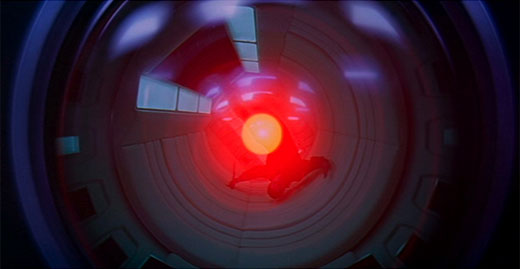
Arthur C. Clarke, in his novel 2001: A Space Odyssey, wrote about a renegade computer that managed to outsmart a team of astronauts on a mission to one of the moons of Jupiter. The novel became a stunning movie in 1968 under the direction of Stanley Kubrick. The murderous computer, HAL 9000, considers himself a conscious entity and finds that he is afraid when he begins to lose his ability to think.[3]

In the Genesis creation account, we read that “God created human beings in his own image. In the image of God he created them; male and female he created them;” and for centuries, theologians and philosophers have been seeking to understand the nature of this imago dei (image of God). We have much yet to learn, but I am convinced that the beginning of wisdom is to take seriously this concept. The more we understand the nature of this image, the greater we will comprehend what it is that makes us truly human. God is a Creator and we are creators. God is in relationship and calls us to be in relationship with him and with others. God is a communicator and we are communicators. God is truth and calls us to truth. God is love and calls us to be love as well.

Whatever the final answers regarding the image of God, we need not fear the AI apocalypse that has been depicted in so many of the stories, movies and writings in our majority culture. God, who created us from the dust of the earth, and created the dust before that, is the ultimate creator and sustainer. He is in control of all life and has set humans to be stewards of His creation. Even as we struggle to achieve this assignment, and sometimes pursue short-cuts to cleaning up the messes we have made, the God of the universe watches us and engages us with gracious concern. May His will be done; for this is what it means to be alive.

Thursday, September 17, 2015

We're Just Here To . . .


Previously I have recommended the Christopher Nolan film Interstellar (here and here) and I will continue to sing its praises even while encouraging us to see it for all it is and look discerningly at its message. As the main character, Cooper, says his good-byes to his family and prepares to leave the galaxy, he makes a statement that suggests depth but perhaps simply reveals the not so deep philosophy of the Nolan brothers who wrote the screenplay for this film.

"We're just here to be memories for our kids." Cooper (Matthew McConaughey) in Interstellar.[1]

On the one hand, this is not a bad concept. If we are here to be memories for our kids, we will want to make certain that the memories we leave behind are good memories and we will likely live good lives. But as a true philosophy of life, it falls far short. Our lives have an existence apart from the lives of our children. I will not get on a soap-box and preach a message that defines my own perspective on the purpose of life. Anyone who reads a few pages of this blog will soon discern what my view on this would be. Instead, I encourage you to think further about why we are here. It must be more than just to be memories for our kids. As we consider the joys and horrors of this life, we must at least admit that our purpose is to contribute to the joys and diminish the horrors. What more would you add to this? How would you answer the question of why we are here?


[1] Interstellar. Directed by Christopher Nolan. Written by Jonathan Nolan and Christopher Nolan. Performed by Matthew McConaughey. 2014.

Monday, September 14, 2015

Exploring Life


New Horizons, Rosetta, Mars Curiosity, The International Space Station, Cassini, Hubble, and Mars Express, many of these missions, spacecraft, and satellites have become well-known to us over the last few years. NASA, ESA, and the international space community have accomplished magnificent feats of exploration and the news media has shown us the significance of these events. We live in the heyday of local solar system exploration: all eight planets in our solar system have been visited and dwarf planets like Pluto and others in the Kuiper Belt have been explored and catalogued. Furthermore, thanks to the Hubble Space Telescope, and other far-reaching imaging systems, we have a much greater awareness of our place in the universe. I am one person who is excited to live in this time and I observe with great joy the new advances in space exploration.

Some would argue that this obsession with worlds beyond our world is unhealthy. They would say that we should be investing in solving the problems on this planet before we explore others. Certainly, we must heed the voices which call us to end poverty, suffering, and violence on Planet Earth, but I would suggest that we also need to give heed to the message of the planets and stars around us. In Christopher Nolan's excellent movie Interstellar, Matthew McConaughey plays an engineer and astronaut who has retired to farming on a planet that desperately needs farmers. Yet, even as he settles into his new role, he laments the days of pioneering and exploration that came to an end as he was beginning his career. In a scene where he is front porch reminiscing and philosophizing with his father-in-law he says,

"We used to look up at the sky and wonder at our place in the stars. Now we just look down, and worry about our place in the dirt."[1]

In one sentence the Nolan brothers capture the angst of our generation. We worry, we wonder, we focus upon our ability to scratch out a living in this dirt, on this earth on which we live. Yet, at the same time, we wonder if there isn't something more beyond this place, beyond this subsistence, and beyond this life.

Could it be that our calling is to keep our eyes on both the dirt at our feet and the stars in the sky? Can we invest in both earth-dust and star-dust? Can we seek right relationships here on earth while looking to the heavens beyond? A life lived in this way will not be easy. It will require continual assessment of our goals, our consumption, and our contributions. It will require us to ask difficult questions about ultimate purposes of lives lived here on earth and of our own life in particular. It will cause us to consider the source of our existence and the gratitude with which we live. Personally, I am up for exploring that kind of life!


[1] Interstellar. Directed by Christopher Nolan. Written by Jonathan Nolan and Christopher Nolan. Performed by Matthew McConaughey. 2014.

Wednesday, May 20, 2015

Venetian Dreams


The popular press has, in recent years, written much about the planet Mars, but very little about Venus. This is to be expected since Mars is the planet of greatest focus for the major space programs of the world. Four planetary rovers have traversed various portions of the Martian surface,1 orbital spacecraft have mapped the surface in great detail, and visionary pioneers have made it their goal to put colonies of humans on Mars.

Yet we should not so quickly ignore the beauty and mystery of Venus. Certainly it would be much more difficult to colonize; yet, as a destination for research and exploration, it is still intriguing. Venus has been compared to our own Earth in a number of ways. Venus has a radius of 6,052 km while Earth has a radius of 6,371 km. Venus has a mass that is 81% of that of Earth. Both are relatively close to our sun. Venus, on average is 108 million km from the sun, while Earth averages 150 million km.2 At their closest, Earth and Venus are only 26 million km apart. Compare this to Earth and Mars that are 34 million km apart at their closest. Due to the elliptical orbits of all three planets, these distances vary widely and there are moments when Earth is closer to Mars than to Venus.3

So, why would it be more difficult to colonize Venus? The answer lies in the thick atmosphere of the planet. Most people recognize that the earth has a greenhouse gas problem, but Venus is the queen of carbon dioxide. Her atmosphere - and yes, the planet has been referred to as feminine ever since it was named after the Greek goddess of beauty - is 96% CO2 and the atmospheric pressure on the surface is 92 times that of our own atmosphere at sea level. That is equivalent to the pressures experienced at a depth of 3000 ft in our own ocean. Spacesuits would not be sufficient to the task; we would need a submarine or bathysphere to be comfortable on the Venetian soil. Even space vehicles built to contemporary standards would be crushed on the surface of this planet. Then there is the heat; the average temperature on Venus is 460 degrees Celsius. For comparison, the average temperature on Earth is 14 degrees, on Mars it is minus 55 degrees, and on Mercury it is 167 degrees Celsius. Venus is our solar system’s hottest planet. All water has long since boiled away and humans would need a lot of air-conditioning to last any length of time on the surface.

Airship colonization has been suggested as one possible way to live on Venus.4 Thirty miles above the surface, the air pressure is one Earth atmosphere. Thus, lighter-than-air balloons might function as research vessels on this planet. Such machines would still need to be well insulated against heat and impervious to high concentrations of sulphuric acid that probably exist at this level in the Venetian atmosphere.5 With a Venetian axis rotation that lasts 243 Earth days, a counter-clockwise rotation around its axis (Uranus is the only other planet in our solar system with a retrograde rotation), a day relative to the sun that is 117 Earth days long, and no moon, it would be a fascinating place to live.6

1.  http://en.wikipedia.org/wiki/Mars_rover
2. http://www.esa.int/Our_Activities/Space_Science/Venus_Express/Venus_compared_to_Earth
3. http://en.wikipedia.org/wiki/Venus
4. http://qz.com/317243/nasa-scientists-want-to-colonize-venus-with-giant-floating-cities/
5. http://www.esa.int/Our_Activities/Space_Science/Venus_Express/Acid_clouds_and_lightning
6. http://en.wikipedia.org/wiki/Venus

Sunday, December 21, 2014

Interstellar 2014

Once again Christopher Nolan (writer and director) and Jonathan Nolan (writer) have succeeded in changing our perceptions with the visually stunning, Interstellar (2014). If you have not seen the movie, you may want to see it before you continue to read this blog which contains elements of the plot (in other words: spoiler alert). From the dust-bowl farmers of the "not-too-distant" future, to scenes of communication across time, I could almost taste the dirt, feel the pull of acceleration and gravity, sense the disorientation of astronauts facing challenges never before experienced, and share the suffering of the families as their lives were torn apart by time and circumstance.

The brothers have collaborated before (Memento (2000) and The Dark Knight Rises (2012); see my analysis of that Batman movie here), but their story-telling gets better each time. Interstellar is subtle; the audience is never subjected to preaching dialogue or pedantic scenes; and even the plot moves along largely through visual and musical elements. Hans Zimmer's score is perfectly suited to their method. There are times when the dialogue is nearly drowned out by the score and flood of potent images; but one soon learns to wait for the resolution of the scene to understand its implications. Many times the film reminded me of the story-telling methodology developed in the Stanley Kubrick and Arthur C. Clarke collaboration, 2001: A Space Odyssey. Many other contemporary writers and directors seem to believe that the audience will not understand a story told through images and so they clutter the story with explanations. The Nolan brothers have recovered an art-form as old as cave-drawings and stained-glass windows and only a few times did they stray from this style. They did choose to explain wormholes and multi-dimensional travel and I could hardly fault them in that choice.

Then there is their visual depiction of a wormhole which is one of their great innovations and one which I am sure other film creators will imitate. Any fan of science fiction will be familiar with the standard depiction of wormholes seen in the Star Trek or Stargate franchises (to mention two of many). The usual images are of a two dimensional hole or lens which opens into a multi-coloured tunnel of stretched light. The creative development in Interstellar is that the wormhole is depicted as a three dimensional sphere and the approach of the Endurance space-craft is shown in a way that resembles an object being drawn into the orbit of a planet. This imagery lends itself to several subtle variations on the theme of wormholes, black-holes, and rapid space travel. At one point the crew of the Endurance skips through the "event horizon" of a black hole to slingshot themselves across a galaxy. I look forward to seeing what other writers and directors might do with such innovations and plot possibilities.

The cast is full of big names in the movie industry and it is somewhat surprising that actors who had smaller roles seemed to be the ones most likely to fail to convince me of their character. I expect that one or two of them will look back on this movie and realize the creative opportunities that were missed.

Near the end of the movie we see a rich interpretation of communication across time and space. The imagery is somewhat reminiscent of the layering of time and space in Christopher Nolan's movie, Inception (2010); but here the key to communication is gravity and not dreams. The Nolans have rightly recognized that one of the last great mysteries of physics is gravity and that the resolution of this mystery will bring about a truly massive revolution in scientific development. They also realistically depict that mankind may never solve this mystery. Here, their art imitates life with an image that reflects perfectly back on their art. The brothers purposely and intelligently refrain from tying-up all of the loose ends and one is left with a sense of wonder and trepidation at the next years of life we may experience on this planet. In life and art, may we continue to encourage and celebrate the risk-takers and pioneers.

Saturday, August 16, 2014

Deep Thoughts by Kilobot 142

The CBC news site had an article about a Harvard research group that built 1,024 tiny robots. The "Kilobots" have three tiny legs and are powered by a rechargeable battery. They express a "hive mentality" in which the researchers can send a signal to the group of robots and they will assemble into groupings of various shapes. For example, the robot creators can "tell" them to make the shape of a starfish and the Kilobots will collectively assemble into a star shape. The system works on a few simple principles related to proximity to other bots, coordinates, and move or be still logic. If a Kilobot is on the edge of a grouping it must "decide" whether to move or not move. If an individual Kilobot is surrounded by other bots it can then "relax" knowing that it will sit still until other bots move away from it, leaving it on an edge. Now of course, as we speak of this, we tend to assign thoughts when there are no thoughts going on. As the writers of the article said, "the Kilobots are not exactly thinking deep thoughts."

This got me thinking, what would Kilobot thoughts sound like? So, with a nod to "Deep Thoughts by Jack Handey" I present to you, "Deep Thoughts by Kilobot #142." (Note, this thought experiment requires cheesy keyboard music - not supplied.)

Wait, where am I? Oh good, middle of the pack.

Livin' large, on the edge!

Why am I here? Har! just kidding.

Who is my creator? Har! just kidding.

Where am I going? Oh, who cares, I'll just follow the others.

Look at the legs on 1017!

Bump! HeaHeaHea!

Battery low - send electrons!

Thursday, May 15, 2014

Europa

The May 17 issue of Science News features a series of articles about Europa, the fourth largest moon of Jupiter. Europa is perhaps the most interesting moon in our solar system. At roughly two thirds the size of our own moon (with a mass of just 0.0080 times the mass of earth) it is still a small world; but what makes it interesting is its potential for life. Whereas Io is covered in volcanoes (over 400 active on the surface) and Callisto and Ganymede are covered in equal parts of silicate rock and water-ice, Europa is completely covered in frozen water. Recent observations suggest that beneath this thick crust of ice lies a vast ocean; and, there is also much conjecture that it could be possible for life to exist in this ocean.

Arthur C. Clarke, the British science fiction writer, imagined an ocean with intelligent life on Europa in his Space Odyssey books (particularly 2010: Odyssey Two and 3001: The Final Odyssey). Clarke is no light-weight when it comes to scientific predictions, having written scientific papers in 1945 that proposed geostationary satellites before the first one was put in place in 1963. Could Clarke have been prophetic about life on Europa? If pressed about his stories of Europa he would surely say that writing of intelligent life was purely imagination; but that simple microbial and bacterial life would be much more of a scientific possibility.

Arthur C. Clarke once said, "I'm always paraphrasing J. B. S. Haldane: 'The universe is not only stranger than we imagine, it's stranger than we can imagine.'"

Today, there are scientists working to test hypotheses about microbial life living in thermal vents in the ocean floor of Europa. If such life could be detected it would be a dramatic discovery that would revolutionize our concepts of life in our solar system and in the universe. Would such life be carbon based? Would they replicate by sexual reproduction? Would they contain deoxyribonucleic acid (DNA)? If they did have DNA would they use the genetic code of the majority of life on earth, the mitochondrial DNA code, or a novel genetic code? Such questions would immediately spring to the minds of scientists and would soon be on the lips of people at Tim Hortons and Starbucks shops around the world. No, this is not some sort of nerdy exaggeration, people would find such things fascinating if such a revolution occurred. Of course the theological ramifications would be significant. The Copernican revolution taught us that the earth is not the astronomical centre of the universe and that the earth revolves around the sun, not the other way around. This had to be considered as humans thought about their place in the universe. Could humans still be a special part of God's creation if they were not located at the geometric centre? The exobiological revolution of finding life on another planet would lead to an exotheological revolution in which we would again need to consider our place in God's economy. We would have to ask, "Is life on earth really all that special?" If life could develop on two separate worlds within one solar system, how many more life forms might there be in the entire universe? Might some of them have developed communication with one another? Could they communicate with us? Might they pray to our same God? Might they pray to another god? All of these questions and more would become much more significant the moment life was detected elsewhere.

The articles in Science News suggest that the ability to fully test the hypotheses is still ten to fifteen years away. I hope to live to see the day when there are ice-drills on Europa as we seek the answers to these interesting questions.


Click on thumb-nail image for a larger photo.


Saturday, October 19, 2013

Apophatic Theology

I happened upon an article at BioLogos which directed me to an article at www.respectfulconversation.net which caused me to reflect on theology, poetry, and Children of God. By the time my brain had come in for a landing it had gone on quite a merry chase. The theme that runs through these perambulations is one that requires further thought and may result in a subsequent article. For now, let me tease you with two quotes. The keeners in the blogosphere will want to follow up on the links and will find themselves going on their own merry chase into theology, science, and the nature of God. Perhaps one of you will beat me to the punch and write a magnificent blog post on "Hubris and the Nature of God."

The article at BioLogos suggests that we might learn from (without completely embracing) a type of theology known as apophatic ("not" and "capable of being spoken") theology. It states that,
Apophatic theology is not simply an exercise in saying what God is not; it is no primer to theological nihilism. Rather, apophaticism is a spiritual and intellectual commitment to recall that our predications about God, even when true and revelatory, are also inadequate caricatures; whatever true things we may say about God fall magnificently short of exhausting or circumscribing him. Recourse to apophatic theology might counterbalance the hubris by which we presume unduly on our understanding about, e.g., the way divine agency operates in creating and sustaining the universe. Apophatic theology is not to be confused with sloppy relativism; it manifests deference to divine transcendence.1

I do not recall coming across the term "apophatic theology" before; but I know I have met the concept in the writings of others and have sensed the reality of the idea in my own thoughts. (Despite my strong opinions, my depth of hubris is shallower than most people think.) Mary Doriah Russell does a marvelous job of capturing the concept in the dialogue within one of her novels.  In Children of God, Russell's characters consider the reality of Christianity and Judaism and question the motivation it brings to their lives.

"Even if it’s only poetry, it’s poetry to live by, Sofia – poetry to die for,” he told her with quiet conviction. He slouched in his chair for a time, thinking. “Maybe poetry is the only way we can get near the truth of God. . . . And when the metaphors fail, we think it’s God who’s failed us!” he cried, grinning crookedly. “Now there’s an idea that buys some useful theological wiggle room!”2

Theological wiggle room?; or theological reorientation? Could it be that our hubris has caused us to believe that we had it all figured out when the truth of how God operates is many fathoms deeper than we have yet imagined? After-all, God's thoughts are not humans thoughts and are wondrously greater than the greatest thoughts we have ever had.


1 http://www.respectfulconversation.net/ae-conversation/2013/10/12/why-conservative-christian-piety-should-animate-evangelical.html
2 Mary Doriah Russell, Children of God. (New York, Fawcett Books, 1998), 145, 146.

Friday, September 13, 2013

V'Ger Has Left The Building

One of the more philosophical Star Trek movies was Star Trek: The Motion Picture released in 1979. The plot line wrestled with what makes humans human; what makes a machine a machine; what makes a sentient being sentient; and what might happen when an alien race encounters a human-made probe. The story revolved around a Voyager space probe (the fictional Voyager 6) that had been repaired by unknown inhabitants of an unknown solar system before being sent back to earth to find its creator. Commander Spock gets the most important line in the movie. In a rare expression of human emotions Spock cries for V'Ger and says, "Each of us... at some time in our lives, turns to someone - a father, a brother, a God... and asks...'Why am I here? What was I meant to be?'"1

These words came to me once more as I read the news that Voyager 1 had left our solar system (the first of two actual Voyager vessels) making it the first human-made object to explore interstellar space.2 Originally launched on September 5th, 1977, it is an example of "boldly going where no one has gone before." Crossing the boundary into this territory places Voyager into space in which the dominance of our star finally fades to imperceptible levels and allows for the measurement of interstellar magnetic fields, galactic particles, and high energy plasma ejected from other stars. Such measurements will enhance our perception of the universe and contribute to our understanding of fundamental questions like "Why am I here?" and "What was I meant to be?"


1 Star Trek: The Motion Picture. Directed by Robert Wise. Performed by Leonard Nimoy. 1979.
2 http://www.sciencenews.org/view/generic/id/353199/description/At_last_Voyager_1_slips_into_interstellar_space